A Closing Window: The Arctic Experiences That May Not Survive the Decade
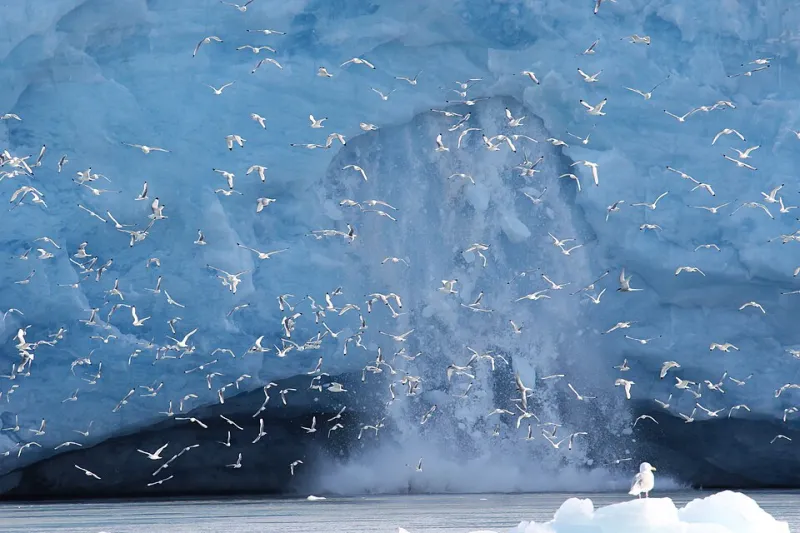
Photo: Gary Bembridge from London, UK, CC BY 2.0, via Wikimedia Commons
The Arctic does not change slowly. That distinction belongs to the geological timescales we learned about in school—the ones that made change feel safely theoretical, safely distant. What is happening in the high north today operates on a different timeline entirely, one measured not in millennia but in field seasons. Researchers who have worked the same routes for twenty years return to find ice shelves reduced to fractions of their former extent, denning grounds shifted, migration patterns disrupted. The landscape that defined polar exploration for centuries is being rewritten in real time.
For travelers considering an Arctic expedition, this reality carries a specific weight. Some of what you have seen in photographs, in documentaries, in the expedition journals of the last generation—some of it is already gone. Some of it is leaving. And some of it remains, for now, exactly as magnificent as it has ever been.
This article is about that last category, and why the gap between "for now" and "not much longer" is smaller than most Americans realize.
The Disappearing Platforms: Sea Ice and What Lives on It
The most immediate casualty of Arctic warming is not a species. It is a surface. Sea ice—the frozen platform that structures virtually every element of high-Arctic ecology—is declining in both extent and thickness at a rate that has consistently outpaced scientific models. The Arctic Ocean is projected to experience its first ice-free summer before 2035, according to research published in Nature Climate Change. Some models place that threshold even earlier.
For wildlife photographers and expedition travelers, this matters enormously. The polar bear encounters that define high-Arctic expeditions are inseparable from sea ice. Polar bears hunt ringed seals from ice platforms; their body condition, denning success, and geographic range are all directly indexed to ice availability. As the summer ice retreats earlier and returns later each year, the window for observing bears in their natural hunting behavior narrows.
Walrus haul-outs, already stressed by the loss of resting ice, are increasingly concentrated on land—creating dangerous overcrowding and altering the behavioral dynamics that photographers have documented for decades. The image of a walrus colony spread across a vast ice floe, unhurried and undisturbed, is already becoming rare. Within the decade, it may be exceptional.
The Routes That Are Closing
The Northeast Passage and the routes through the Svalbard archipelago have historically required specific ice conditions to navigate safely and meaningfully. Paradoxically, while warming has opened some routes to commercial shipping, it has destabilized the ice conditions that make certain expedition routes both navigable and experientially rich.
The fast ice fjords of northeastern Svalbard—areas where expedition vessels have historically moved through dramatic ice architecture, past calving glaciers and into remote inlets accessible only a few weeks per year—are losing their defining character. Glaciers that once calved dramatically into fjords are retreating onto land. The ice caves and pressure ridges that have made certain routes visually extraordinary are thinning and, in some cases, collapsing.
Isbjørn Adventure's expedition planners have already adjusted several traditional routes in response to changed conditions. Some of the most iconic waypoints in Arctic expedition history are no longer reliably reachable in the form that made them legendary.
What the Science Is Actually Saying
It would be dishonest to present this as a uniform narrative of loss. The Arctic is not simply diminishing—it is transforming, and transformation creates its own forms of access and observation. Some species are expanding their ranges northward. Certain fjords that were previously choked with ice for most of the year are now navigable for longer seasons, making remote coastlines accessible to expedition vessels that could not have reached them a generation ago.
But the specific experiences that draw serious polar travelers—the ones that cannot be replicated at lower latitudes or in more temperate wilderness—are disproportionately tied to cold, to ice, and to the ecological relationships that depend on both. It is precisely these experiences that are most vulnerable.
Dr. Lena Hartvik, a glaciologist at the University of Tromsø whose research has focused on Svalbard's ice dynamics, is direct about the timeline: "We are not talking about gradual change that future generations will manage. We are talking about specific, named glaciers and specific, named habitats that will be fundamentally altered within the careers of researchers currently in the field. The window for witnessing certain phenomena in their current state is measured in years, not decades."
The Case for Going Now—And Going With Purpose
Isbjørn Adventure has always understood Arctic expeditions as something more than tourism. The travelers who venture above the Arctic Circle with us are, whether they frame it this way or not, witnesses. They carry back photographs, observations, and firsthand accounts that contribute to a collective record of a landscape in transition. In an era of accelerating change, that witness function carries genuine weight.
There is a growing movement among expedition travelers—particularly in the American market, where adventure tourism intersects increasingly with environmental consciousness—to treat polar travel as a form of documentation. Participants share images, contribute to citizen science programs, and return home as credible, firsthand voices in conversations about Arctic conservation and climate policy. An Isbjørn expedition is not a passive experience. It produces informed advocates.
This is not a guilt-based argument for travel. Flying to Svalbard has a carbon cost, and any honest assessment of Arctic tourism must acknowledge that. But the alternative—leaving these places unwitnessed, undocumented, and outside the lived experience of the people who shape policy and public opinion in the United States—carries its own cost.
The Specific Experiences on the Clock
For travelers weighing when to go, the following experiences represent the highest priority from a temporal standpoint, based on current climate trajectories:
Glacier calving in Svalbard's eastern fjords. Several of the most visually dramatic calving fronts have already retreated significantly. Those that remain are among the most accessible and spectacular on Earth—for now.
Polar bear observation on sea ice. The combination of reliable ice, accessible habitat, and stable bear populations that currently characterizes certain Svalbard routes is a convergence that climate models suggest will become increasingly difficult to achieve.
Walrus on sea ice. Distinct from land-based haul-outs, ice-platform walrus observation is already rare and becoming rarer. This is one of the most time-sensitive wildlife experiences in the Arctic.
The silence of intact wilderness. This is harder to quantify but no less real. As ice retreats and shipping routes open, the profound acoustic and visual stillness of the high Arctic—the sense of being genuinely beyond the reach of industrial civilization—is itself a diminishing resource.
The Window Is Open
The Arctic is not gone. It is not even, in most of the ways that matter to an expedition traveler, diminished beyond recognition. What is true is that the margin between "this is still possible" and "this is no longer what it was" is shrinking with a speed that demands attention.
Isbjørn Adventure exists because we believe the high Arctic is among the most important places on Earth to experience directly. We also believe that the most honest thing we can tell prospective travelers is this: the version of the Arctic that exists today—the one with the ice, the bears, the silence, the glaciers—is not guaranteed to exist in the form you are imagining for much longer.
Go now. Go with your eyes open. Go with a camera, a notebook, and the intention to carry what you witness back into a world that needs to hear it.