What the Ice Teaches: How Polar Expeditions Rewire the American Relationship With Fear
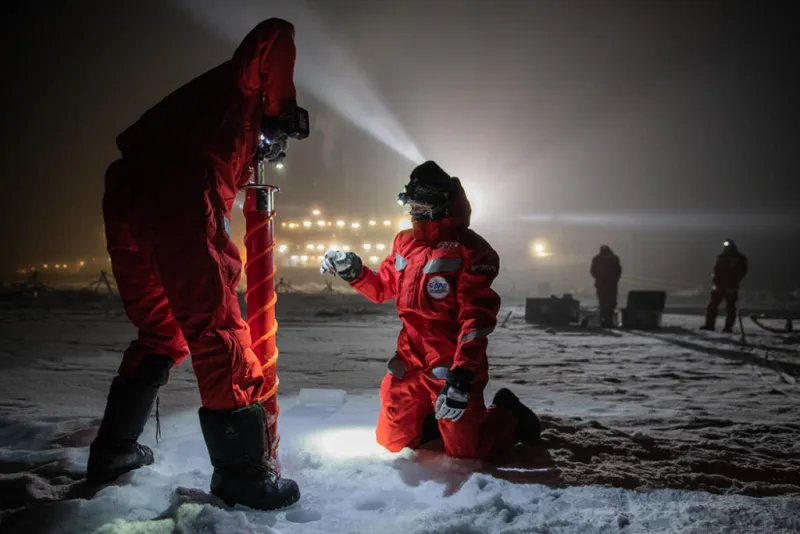
Photo: person standing on Arctic sea ice whiteout polar expedition, via mosaic-expedition.org
There is a particular moment that nearly every Isbjørn Adventure alumni describes in nearly identical terms. They are somewhere above 78 degrees north latitude. The wind has picked up without warning. Visibility has dropped. The guide raises a fist—the universal signal to stop moving—and the group stands in near-whiteout silence, waiting. In that moment, all of the noise of ordinary American life—the deadlines, the notifications, the ambient hum of low-grade anxiety that most of us carry like a second coat—simply stops.
What replaces it is not panic. It is, almost universally, a strange and clarifying focus.
"I expected to be terrified," says Marcus Delray, a 44-year-old civil engineer from Portland, Oregon, who completed an Isbjørn high-Arctic expedition two summers ago. "Instead, I felt more present than I have in years. My brain just locked onto what was actually in front of me. There was no room for anything else."
This is not an accident of personality. It is, according to researchers who study human stress responses, a predictable neurological event—one that the Arctic environment triggers with unusual reliability.
The Neuroscience of Genuine Danger
Dr. Anya Forsythe, a behavioral psychologist based in Boulder, Colorado, who has studied risk perception in extreme-environment travelers, explains that the modern American mind is, in a sense, poorly calibrated. "We evolved to respond to immediate, physical threats," she says. "But most of the stressors in contemporary life are chronic and abstract—financial pressure, social comparison, career uncertainty. Our threat-response system activates for these things, but it never fully resolves. The danger never actually arrives or departs."
The Arctic, she argues, offers something genuinely rare: real, legible, physical risk with clear parameters. A polar bear is either approaching or it is not. The temperature is either survivable with your current gear or it requires immediate action. "The brain knows how to handle that," Forsythe says. "And when it handles it successfully—when you navigate a genuine threat and come through intact—the recalibration that follows is profound."
This recalibration has a name in psychological literature: post-traumatic growth. Researchers have long documented that individuals who face and survive meaningful adversity often emerge with heightened resilience, a revised sense of personal capability, and a measurably reduced sensitivity to minor stressors. What makes Arctic expeditions unusual is that they produce this effect without requiring trauma. The danger is managed, guided, and—in the hands of experienced polar professionals—navigated safely. The psychological benefit arrives without the cost.
From the Ice to the Office
The transfer of this recalibration into everyday life is where the stories become most compelling. Expedition alumni consistently report that their tolerance for ordinary frustration increases markedly after returning from the high Arctic. Traffic jams, difficult colleagues, delayed flights—these register differently when measured against the memory of standing in a polar whiteout or spotting a male polar bear at close range.
Sarah Nguyen, a 38-year-old marketing director from Chicago who joined an Isbjørn Svalbard expedition last spring, describes it this way: "I used to catastrophize constantly. Every work crisis felt like the end of the world. After the expedition, I started asking myself: 'Is this actually dangerous? Does this require my full fight-or-flight response?' And the answer was almost always no. The Arctic gave me a reference point for what real difficulty looks like."
This is not simply a matter of perspective-shifting in the abstract, feel-good sense. Research published in the Journal of Experiential Education suggests that individuals who complete high-stakes wilderness expeditions demonstrate measurable improvements in risk-assessment accuracy—meaning they become better, not merely more relaxed, at distinguishing genuine threats from perceived ones. The Arctic, in other words, does not make people reckless. It makes them more precise.
The Role of the Guide
It is worth noting that this transformation does not occur in an unstructured encounter with danger. The presence of experienced polar guides is not incidental to the psychological outcome—it is central to it. Isbjørn Adventure's expedition leaders are trained not only in Arctic survival and wildlife protocols but in the art of calibrated challenge: presenting guests with difficulty that is meaningful without being overwhelming, building competence incrementally so that each small success lays the groundwork for the next.
"The best polar guides are essentially architects of confidence," says Forsythe. "They create the conditions under which people discover capabilities they didn't know they had. That discovery is what sticks."
Delray echoes this: "Our guide never made us feel like passengers. We were reading ice conditions, making decisions, taking responsibility. By the end of the week, I trusted myself in a way I hadn't since I was young."
What You Carry Home
The Arctic is indifferent to human ambition, sentiment, and self-perception. It does not reward bravado or penalize self-doubt. It simply presents conditions, and those conditions require response. For Americans accustomed to environments engineered for comfort and convenience, this indifference is, paradoxically, a gift.
The expedition ends. The gear is packed. The flight south returns travelers to familiar latitudes and familiar pressures. But something in the architecture of the mind has shifted. The fear is still there—fear is never eliminated, nor should it be—but its proportions have changed. What once loomed large has been quietly reclassified. What once seemed unbearable has been placed in context.
The polar bear spotted at dawn on the third day of the expedition. The whiteout navigated without incident. The cold that was, in fact, survivable. These are not just memories. They are, as more than one Isbjørn alumni has described them, internal landmarks—fixed points to navigate by long after the ice has receded from view.
The Arctic does not make you fearless. It makes you accurate. And in a world engineered to manufacture anxiety, that may be the most radical transformation of all.