Cold as Medicine: The Science of Why Arctic Extremes Produce a Feeling No Beach Can Match
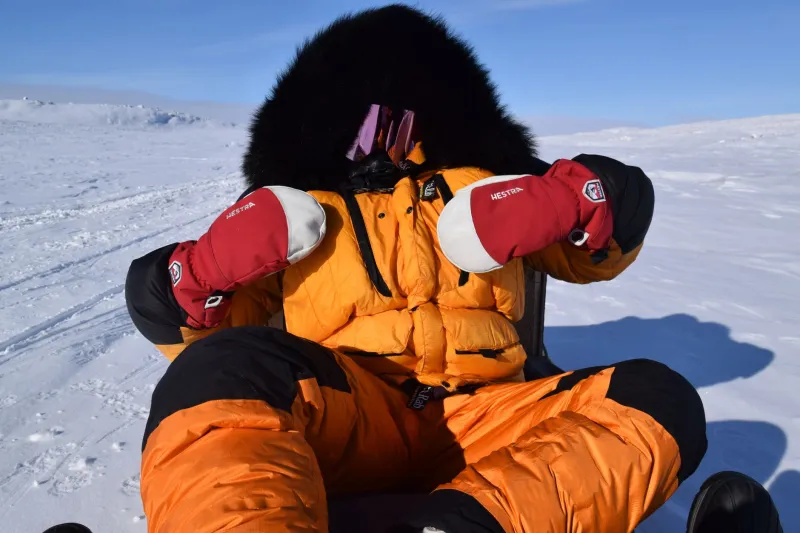
Every January, millions of Americans book flights south. They chase warmth, stillness, and the particular comfort of doing very little under a generous sun. The logic is intuitive: rest restores, heat soothes, and ease replenishes whatever the year has depleted. Yet a growing body of physiological research — and the testimony of those who have traveled in the opposite direction — suggests that this formula may be precisely backward.
The people who return from Arctic expeditions do not describe rest. They describe awakening.
What Happens to the Body at the Edge of Cold
When the human body encounters genuine cold — not the mild chill of an air-conditioned hotel lobby, but the sustained, penetrating cold of an Arctic morning at minus twenty Celsius — it initiates a cascade of responses that have no equivalent in temperate environments.
The sympathetic nervous system activates immediately. Norepinephrine, a neurotransmitter associated with alertness and focused attention, surges through the bloodstream. Brown adipose tissue, the metabolically active fat that generates heat, begins burning at an accelerated rate. Circulation tightens toward the body's core, sharpening the contrast between the cold pressing in from outside and the warmth the body is working to defend.
This is not stress in the chronic, corrosive sense that most Americans experience it. It is acute stress — the kind the human organism was designed to process. Cortisol rises, yes, but briefly and purposefully. In the absence of a sustained threat, the body resolves that cortisol spike efficiently, leaving behind a biochemical residue that researchers associate with improved mood, heightened sensory acuity, and a pronounced sense of physical presence.
In simpler terms: the cold reminds your body that it is alive, and your body responds with something close to gratitude.
The Sensory Argument for Polar Travel
One of the quieter casualties of modern American life is sensory range. The average adult in a mid-sized U.S. city moves through environments that are temperature-controlled, acoustically managed, visually saturated with artificial light, and largely insulated from any stimulus that might be described as extreme. The nervous system adapts. It narrows. Stimuli that would once have registered as remarkable become background noise.
The Arctic reverses this process with considerable force.
In the high latitudes, the air carries a clarity that has no urban equivalent — a sharpness that makes each breath feel like information rather than mere function. Sound behaves differently across frozen tundra and sea ice; the absence of the ambient noise Americans accept as normal creates an acoustic environment so unfamiliar that it registers, at first, as slightly disorienting. Light, particularly during the polar day or in the low-angled gold of an Arctic autumn afternoon, possesses a quality that photographers travel thousands of miles to capture and that no filter adequately replicates.
Each of these conditions demands genuine attention. The nervous system, suddenly presented with stimuli it cannot process on autopilot, re-engages in ways that feel, to those experiencing them, like a form of waking up. The clinical term is sensory salience. The experiential term, used repeatedly by expedition travelers returning from Svalbard or the Norwegian High Arctic, is simply: I felt everything.
Perceived Danger and the Architecture of Deep Satisfaction
There is a distinction worth drawing between actual danger and perceived danger, and it is one that responsible polar expedition operators understand well. A properly guided Arctic journey is not reckless. Safety protocols, experienced guides, quality equipment, and meticulous logistics reduce genuine risk to acceptable levels. But the environment itself — the scale of the ice, the visibility of wildlife that operates outside human hierarchies, the physical demands of moving through extreme terrain — generates a perception of consequence that is both real and clarifying.
Researchers studying what psychologist Mihaly Csikszentmihalyi described as flow states have consistently found that the conditions most likely to produce deep satisfaction involve a meaningful match between challenge and capability. The Arctic provides challenge in forms that are unambiguous and physical — cold that must be managed, distances that must be respected, attention that cannot lapse. When a traveler successfully navigates those conditions, the satisfaction produced is categorically different from the mild pleasure of a comfortable vacation.
It is earned. The body knows the difference.
This may explain why so many Americans who travel to polar regions for the first time describe the experience not as a vacation they enjoyed but as a threshold they crossed. The language shifts from leisure to transformation. That shift is not poetic exaggeration. It reflects a genuine neurological event.
Why Warmth Alone Does Not Restore
None of this is an argument against rest, and Isbjørn Adventure does not suggest that recovery and ease have no place in a well-designed life. But the assumption that warmth and passivity are the default conditions for restoration deserves scrutiny.
The human nervous system did not evolve in climate-controlled environments. It evolved in conditions that required ongoing physical engagement with an unpredictable world. The mild, managed discomfort of cold-weather travel — the need to layer thoughtfully, to move with purpose, to remain attentive to changing conditions — activates systems that lie dormant in the average American's daily routine. Those systems, when activated and then allowed to resolve, produce a quality of well-being that is biochemically distinct from relaxation.
Some expedition travelers describe it as a reset. Others call it clarity. A few, searching for language adequate to the experience, simply say they felt more like themselves than they had in years.
The Case for Choosing Discomfort Deliberately
The Arctic does not offer comfort in the conventional sense, and it does not pretend to. What it offers instead is something rarer and, for many travelers, more durable: the experience of engaging fully with an environment that demands your complete presence.
In that demand lies the paradox. The place that seems least hospitable to human flourishing — cold, remote, stripped of the conveniences Americans have come to regard as baseline — turns out to be among the most effective environments for producing the feeling that most Americans are actually seeking when they book a vacation: the sense of being genuinely, unmistakably alive.
The beach will be there. The Arctic, in the form it currently takes, may not be — and the vitality it produces cannot be approximated anywhere else.
That is reason enough to go north.


