From the Ice to the Office: How Polar Expeditions Forge Sharper, Calmer Professionals

Photo by Photo by Raed Kasrwani on Unsplash on Unsplash
The Arctic does not care about your quarterly targets. It does not acknowledge your title, your inbox, or the particular brand of organizational chaos you have been navigating since January. What it offers instead is something far more clarifying: a set of conditions so extreme, so stripped of the familiar scaffolding of modern professional life, that the mind is left with no choice but to rebuild its operating logic from the ground up.
For a growing cohort of American executives, designers, attorneys, and entrepreneurs, this is precisely the point. Polar expeditions — once the exclusive domain of scientists and explorers — have emerged as an unlikely but remarkably effective form of professional development. The return on investment, as several veterans of high-latitude travel will attest, is not measured in networking contacts or conference takeaways. It is measured in the quality of decisions made under fog, in the steadiness of voice during a crisis, and in the capacity to sit with uncertainty long enough to find a genuinely good answer.
The Minimalism Principle: When Less Becomes More
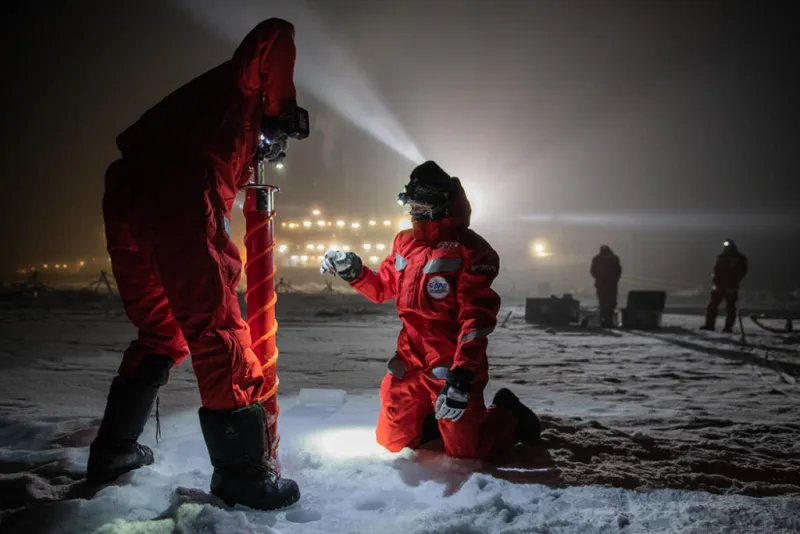
One of the first lessons the Arctic imposes is ruthless prioritization. On an expedition — whether traversing Svalbard by snowmobile or navigating the fjords of northern Norway aboard a small vessel — every item you carry must justify its weight. Every decision about route, timing, and risk carries real consequence. There is no room for the performative busyness that consumes so much energy in open-plan offices.
Marcia Ellison, a senior vice president at a Chicago-based logistics firm, completed a ten-day Svalbard expedition in the spring of 2022. She describes the experience as a forced audit of her professional habits. "Back home, I had confused motion with progress for years," she says. "On the ice, you learn very quickly that unnecessary movement costs you warmth, energy, and time. I came back and applied that exact principle to how I run my team. We cut three standing meetings that week and haven't looked back."
This compression of complexity into its essential elements — a hallmark of genuine Arctic travel — has a measurable effect on cognitive clarity. When the environment demands that you distinguish between what is necessary and what is merely habitual, the skill transfers. Professionals who have operated under polar constraints consistently report a heightened ability to identify the load-bearing decisions within a project and to delegate or eliminate the rest.
Decision-Making in the Fog: Embracing Productive Uncertainty
The Arctic is, by nature, an environment of incomplete information. Weather windows close without notice. Wildlife encounters cannot be scheduled. Navigation requires constant recalibration against conditions that shift faster than any forecast can reliably predict. Expedition leaders on the high Arctic do not wait for certainty before acting — they develop a practiced tolerance for ambiguity, making sound judgments with the best available data and adjusting course as new information emerges.
This is, of course, an exact description of what effective leadership demands in any industry.
Daniel Forsythe, a creative director at a mid-sized advertising agency in Austin, Texas, spent eight days on a guided polar expedition along the northern coast of Norway. He arrived skeptical that the experience would translate professionally. He left with what he now calls a "recalibrated relationship with not-knowing."
"In my industry, there's enormous pressure to project confidence even when the brief is unclear or the data is contradictory," Forsythe explains. "After navigating actual whiteout conditions — where you genuinely cannot see three feet ahead and you still have to keep moving — I stopped being afraid of ambiguity at work. I started treating it as the normal creative condition rather than a problem to be solved before the real work begins."
The psychological literature supports this observation. Research on high-stress adaptive environments consistently demonstrates that individuals who have operated under genuine uncertainty — not simulated, gamified, or workshop-based uncertainty, but the real kind — develop more flexible cognitive frameworks for problem-solving. They become better at holding competing hypotheses simultaneously and less prone to premature closure on a single solution.
Forced Presence: The Antidote to Fragmented Attention
There is perhaps no professional complaint more universal among American workers in 2024 than the inability to sustain deep focus. The architecture of modern work — notifications, open offices, the ambient hum of digital obligation — has systematically eroded the capacity for concentrated, unhurried thought. The consequences for creative and strategic work are significant.
The Arctic addresses this problem without ceremony. There is no cellular service on a glacier. There is no Wi-Fi at the edge of a sea ice floe. There is only the task immediately before you: reading the ice, managing your warmth, observing the behavior of a polar bear moving along a distant ridge. The environment enforces a quality of attention that most professionals have not experienced since childhood.
Sarah Kimura, a partner at a San Francisco law firm, took a ten-day expedition to Greenland's west coast two years ago following what she describes as a period of professional burnout. "I had forgotten what it felt like to be fully inside a single moment," she says. "On the expedition, there was no choice. You had to be there completely. And when I came back, I realized I had been giving my clients — and my own thinking — maybe thirty percent of my attention for years. That changed."
The effect is not merely motivational. Neurologically, sustained single-task engagement strengthens the prefrontal circuits associated with executive function — the same circuits responsible for planning, impulse control, and the kind of measured judgment that distinguishes senior leadership from reactive management.
The Return: Carrying the Ice Back With You
None of this is to suggest that an Arctic expedition is a productivity seminar with better scenery. The value is not instrumental in any simple sense. What the polar environment offers is more fundamental: a temporary removal from the conditions that have made a person professionally brittle, followed by an immersive encounter with conditions that demand a different, more essential version of competence.
The professionals who return from genuine high-latitude expeditions — not cruise ship excursions with cocktail hours, but real expeditions involving physical challenge, navigational uncertainty, and sustained exposure to one of the planet's most demanding environments — do not simply come back relaxed. They come back reorganized.
At Isbjørn Adventure, our expedition packages are designed with precisely this depth of experience in mind. Whether you are considering a first journey into Svalbard's interior or a more demanding traverse of remote Norwegian coastal terrain, the itineraries are built around genuine engagement with the environment — not a curated impression of it.
The Arctic will not improve your PowerPoint slides. It will do something considerably more useful: it will remind you, in terms that are impossible to argue with, what clear thinking actually feels like. That, it turns out, is the rarest and most transferable skill of all.