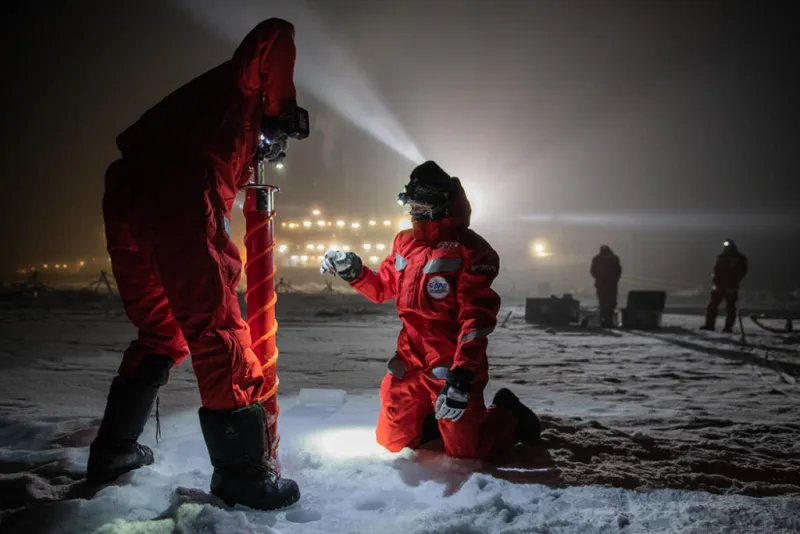
Silence as a Service: The Growing American Demand for Polar Isolation

Photo by Photo by Kate Kasiutich on Unsplash on Unsplash
The Noise We Cannot Escape
There is a particular kind of exhaustion that no amount of sleep seems to cure. It accumulates not in the muscles but somewhere deeper — in the attention itself. Neurologists have a term for it: directed attention fatigue. The condition emerges when the brain is forced to continuously filter, prioritize, and respond to stimuli across digital and social environments. For many Americans, that condition has become a permanent baseline.
In 2024, the average American adult spent more than seven hours per day interacting with screens. Push notifications, ambient news cycles, the relentless social arithmetic of likes and replies — these are not trivial irritants. Research from the University of California, San Francisco, suggests that chronic digital overstimulation suppresses the brain's default mode network, the neural architecture responsible for introspection, creativity, and emotional integration. In plain terms: constant connectivity makes it structurally difficult to think clearly or feel deeply.
This is precisely the context in which Arctic expedition travel has found a new and unexpected audience.
Why the Polar Regions Offer What No Wellness Retreat Can
The market for intentional disconnection is not new. Digital detox retreats, silent meditation centers, and off-grid glamping operations have proliferated across the American West and New England for more than a decade. Yet expedition leaders at Isbjørn Adventure consistently report that clients who have attempted those alternatives describe them as insufficient — aesthetically pleasant, but ultimately unconvincing. The phone still exists in the pocket. The return flight is already booked. The world is still within reach.
The Arctic is categorically different.
When a vessel crosses into the high latitudes of Svalbard or northeastern Greenland, the cellular infrastructure simply disappears. There is no roaming signal, no satellite messaging app running quietly in the background, no ambient WiFi to reconnect to during a moment of weakness. The disconnection is not chosen minute by minute — it is imposed by geography. And according to clients who have made the journey, that distinction is everything.
"I had tried every version of unplugging you can do while still being in America," said one participant on a recent Isbjørn expedition to the Svalbard archipelago, a financial consultant based in Chicago. "What I found in the Arctic was different. It wasn't that I chose not to check my phone. It was that there was nothing to check. The option was gone. Within 48 hours, I felt something I hadn't felt in years. I felt actually present."
The Neuroscience of Extreme Environments
The psychological shift that expedition travelers describe is not merely anecdotal. Research into what cognitive scientists call restorative environments suggests that natural settings — particularly those characterized by vastness, low sensory complexity, and the absence of human infrastructure — actively replenish directed attention. The Arctic, with its unbroken horizons, its silence interrupted only by wind and ice, and its near-total absence of human imprint, represents perhaps the most potent restorative environment available to the modern traveler.
Dr. Rachel Kaplan and Stephen Kaplan, whose Attention Restoration Theory remains foundational in environmental psychology, identified four qualities that allow natural environments to restore cognitive function: a sense of being away, fascination, extent (the feeling of being within a larger coherent world), and compatibility with one's needs. The polar landscape satisfies all four at an intensity that few environments on Earth can match.
Expedition guides with Isbjørn Adventure observe behavioral changes in clients that align closely with this framework. Within the first two days at sea, guests who arrived visibly tense and distracted begin to slow down. They linger at the rail watching pack ice drift. They sit in silence during wildlife briefings rather than reaching for cameras immediately. By the end of a ten-day voyage, many describe a reorganization of their inner priorities that they struggle to articulate but feel certain is real.
The Economics of Scarcity
There is a straightforward market logic underlying this phenomenon. When a commodity becomes rare, its perceived value rises. Genuine solitude — the kind that cannot be approximated by noise-canceling headphones or a weekend cabin rental — has become extraordinarily scarce in American life. The Arctic offers it in abundance.
This is reflected in the pricing and positioning of high-latitude expedition packages, which have shifted meaningfully over the past decade. Where Arctic travel was once marketed almost exclusively on the basis of wildlife spectacle — polar bears, walrus colonies, migrating seabirds — operators including Isbjørn Adventure now field consistent inquiries from clients who lead with the language of mental health and cognitive recovery. They are not asking primarily about what they will see. They are asking about what they will be able to stop doing.
This shift has also altered the demographic profile of expedition travelers. The archetype of the retired naturalist or the hardcore adventure athlete remains present, but it has been joined by a distinct new cohort: professionals in their late thirties and forties, often working in technology, finance, or media, who describe their polar journeys not as vacations but as therapeutic interventions. Some arrive on doctor's recommendations. Several have described the decision in terms that would not be out of place in a clinical context: they came because they recognized that their relationship with attention and rest had become unsustainable.
Planning a Journey With Intention
For those drawn to the Arctic for its restorative qualities rather than — or in addition to — its natural spectacle, the structure of an expedition matters considerably. A vessel-based itinerary, such as those Isbjørn Adventure operates through the Norwegian archipelago of Svalbard or along the remote coastlines of East Greenland, offers an ideal framework. The ship itself becomes a contained world, its rhythms governed by tides, wildlife sightings, and weather rather than by schedules or obligations.
Guided shore excursions into glacial terrain, zodiac cruises among calving icebergs, and extended periods of open observation from the deck all serve the same fundamental purpose: they give the attention something genuinely worth attending to. The brain is not suppressed or sedated. It is redirected toward the immediate and the immense.
Travelers planning their first polar expedition with recovery in mind should consider extending their journey beyond a week where possible. The first several days are often spent in a kind of decompression — the nervous system still anticipating the next notification, the mind still cycling through unfinished professional tasks. The deeper restoration, the kind that clients describe as genuinely transformative, tends to emerge in the second week.
What You Bring Back
The return from an Arctic expedition is, by many accounts, as significant as the journey itself. Clients consistently report that the silence they encountered does not simply end at the airport. It leaves a residue — a recalibrated sense of what deserves attention and what does not, a lowered tolerance for unnecessary noise, and a clearer awareness of the conditions under which they actually think well.
In a cultural moment defined by the compulsive colonization of every quiet moment by digital content, that recalibration may be the most valuable thing a traveler can acquire. The Arctic does not offer it cheaply or conveniently. But for those who make the journey, it offers it completely.