What a Polar Bear Knows That Your Leadership Coach Doesn't
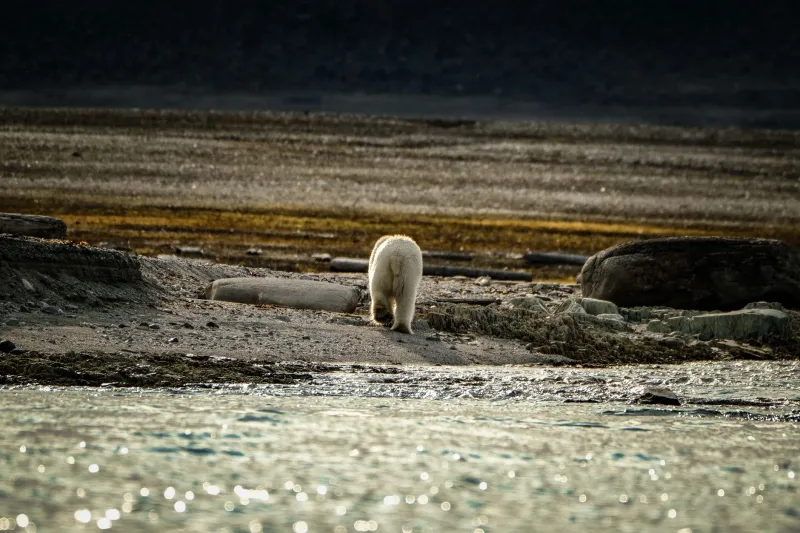
There is a particular moment that expedition guides at Isbjørn Adventure describe with striking consistency. A traveler—often a senior professional, accustomed to schedules, deliverables, and the controlled vocabulary of boardroom life—watches a polar bear for the first time from the deck of a vessel somewhere north of Svalbard. The bear is doing very little. It is waiting. And within minutes, the traveler has gone completely quiet.
Something shifts. The bear has not performed. It has not motivated. It has simply existed, with an unhurried authority that renders most of what passes for leadership wisdom back home suddenly thin.
This is not a metaphor. It is a documented pattern among expedition participants, and it points toward a form of learning that the American self-help industry—a sector worth more than $13 billion annually—has largely failed to replicate.
The Curriculum No Conference Can Offer
The polar bear (Ursus maritimus) occupies a position at the top of one of the most volatile food chains on Earth. The sea ice it depends upon is perpetually shifting, seasonally vanishing, and structurally unpredictable. Its prey—primarily ringed seals—is elusive, fast, and attuned to danger. The bear's survival requires not brute force alone, but a sophisticated integration of patience, spatial awareness, energy conservation, and decisive action at precisely the right moment.
Behavioral ecologists who study high-Arctic ursids have noted that adult bears can wait motionless at a seal's breathing hole for hours, sometimes longer, without any guarantee of reward. They do not catastrophize the wait. They do not abandon the strategy prematurely. They hold a posture of readiness that is entirely free of performance anxiety.
For professionals who have sat through workshops on "executive presence" and "strategic patience," watching this in person carries a particular weight. The bear is not trying to embody a principle. It is the principle.
Adaptability Without the Buzzword
Few words are more overused in American professional culture than adaptability. It appears in job descriptions, annual reviews, and keynote addresses with such frequency that it has been largely drained of operational meaning. What an Arctic expedition restores is the original stakes of the concept.
Polar bears shift their behavior dramatically across seasons. During the ice-rich months, they are active hunters, covering enormous distances across frozen terrain. When the ice retreats in summer, many bears enter a state of walking hibernation—reducing metabolic output, conserving fat reserves, and enduring weeks of caloric scarcity without behavioral collapse. They do not spiral. They recalibrate.
Expedition participants who observe this metabolic and behavioral flexibility often describe it as confrontational in the best sense. One traveler, a marketing executive from Chicago who joined an Isbjørn summer voyage along the Svalbard archipelago, put it plainly: "I've been in companies that folded under far less pressure than a bear handles every single year. Watching that animal made me reconsider what I actually mean when I say something is difficult."
That kind of recalibration is difficult to engineer in a hotel conference room in Phoenix.
What Behavioral Science Adds to the Picture
The experiential dimension of wildlife observation is not merely poetic. Research in environmental psychology has consistently found that extended time in natural settings—particularly those involving the observation of large, autonomous animals in authentic habitats—produces measurable reductions in cognitive overload and significant improvements in attentional restoration. The mechanisms involve the brain's default mode network, which benefits from the low-demand, high-stimulation environment that a tundra or ice-edge landscape provides.
Beyond stress reduction, there is something more specific at work when the observed animal is a capable, apex predator operating without human assistance. Psychologists who study awe and perspective-taking have found that witnessing genuine competence in a non-human context can disrupt the kind of self-referential rumination that underlies much of what executives describe as burnout or decision fatigue.
In plain terms: watching something that is genuinely good at surviving makes you think differently about your own challenges. The bear does not know it is teaching. That may be precisely why the lesson lands.
The Patience Problem in American Professional Culture
American work culture maintains an uneasy relationship with patience. It is praised in the abstract and penalized in practice. Quarterly earnings cycles, rapid product iteration, and the always-on nature of digital communication have collectively shortened the professional attention span in ways that most organizations have not adequately addressed.
The polar bear offers a corrective that is almost confrontationally simple. A mature bear that has survived multiple Arctic winters has done so in part because it does not confuse urgency with effectiveness. It moves when movement is warranted. It conserves when conservation is the superior strategy. It does not perform busyness.
For expedition travelers who spend days in proximity to these animals—observing from Zodiac crafts, from elevated tundra positions, or from the reinforced viewing areas of an expedition vessel—this rhythm becomes internalized in a way that a forty-five-minute TED Talk simply cannot achieve. Duration matters. Context matters. The cold matters.
Why the Arctic Specifically
One might reasonably ask whether any wildlife encounter would produce similar effects. The answer, based on both expedition feedback and the environmental psychology literature, is that the Arctic context amplifies the lesson considerably.
The landscape itself is stripped of distraction. There are no hotels visible on the horizon, no ambient noise from highways or cities, no competing stimuli pulling at attention. The bear exists against a backdrop of ice, sky, and silence that forces the observer into a quality of presence that most Americans encounter rarely, if ever. The cold—genuine, penetrating, impossible to ignore—grounds the experience in the body rather than the intellect.
This is not incidental. The physical sensation of cold, the visual austerity of the environment, and the knowledge that one is genuinely far from the familiar all combine to create what expedition leaders at Isbjørn Adventure describe as a heightened receptivity. People in that state observe differently. They remember differently. They integrate what they have seen at a deeper level.
The Encounter as Inflection Point
Personal development literature is filled with the language of transformation, but genuine inflection points are rarer and less predictable than the genre suggests. What Isbjørn expeditions have observed across years of guiding American travelers through the High Arctic is that wildlife encounters—particularly extended, unhurried observations of polar bears in authentic habitat—function as exactly that: moments after which the traveler's frame of reference has demonstrably shifted.
This is not the company's marketing. It is the consistent testimony of people who came north expecting extraordinary scenery and left with something harder to name but more durable in its effects.
The polar bear does not offer a framework. It does not provide takeaways. It simply demonstrates, with complete indifference to your presence, what it looks like to be genuinely equipped for the environment you inhabit.
That, it turns out, is the most valuable professional development available. It just requires traveling to the edge of the world to find it.