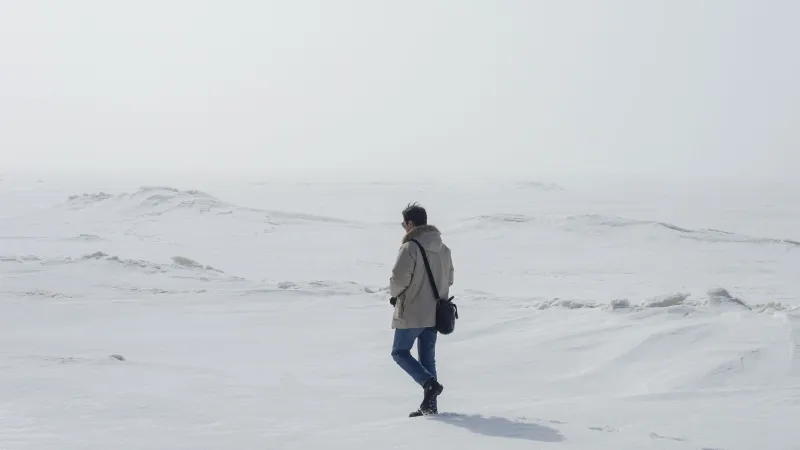
The Case for Darkness: How Polar Winter Rewires Executive Thinking

There is a particular kind of exhaustion that has nothing to do with sleep. American professionals know it well — the slow erosion of judgment that accumulates across a year of relentless stimulation, back-to-back decisions, and a culture that equates busyness with productivity. Most remedies on offer involve beaches, silence, and sunlight. The Arctic, counterintuitively, offers something far more effective: deliberate, total darkness.
At Isbjørn Adventure, we have observed something consistent across our winter expedition clients. Those who arrive braced for the psychological burden of polar night frequently depart describing it as the most cognitively clarifying experience of their professional lives. This is not anecdote. It is, increasingly, science.
What Happens to the Brain When Daylight Disappears
The human circadian system is calibrated by light. Specifically, it responds to the intensity, spectrum, and timing of ambient illumination to regulate cortisol release, melatonin production, and the cycling of alertness across a 24-hour period. In the ordinary American environment — where artificial light extends the perceived day well past midnight and screens emit blue-spectrum light at all hours — this system is under near-constant interference.
The result is what chronobiologists refer to as circadian disruption: a condition in which the brain's internal clock loses coherence with the external environment. The downstream effects include impaired working memory, reduced impulse control, and a measurable decline in the quality of complex decision-making. Crucially, many high-performing professionals operate in this compromised state chronically, without recognizing it as such.
The Arctic winter presents a radically different set of conditions. Above 70° North in December and January, the sun does not rise at all. Ambient light levels remain consistently low, and the absence of competing photonic signals allows the circadian system to consolidate rather than fragment. Melatonin cycles become more pronounced and regular. The brain, no longer required to suppress its natural rhythms against artificial cues, begins to operate with a coherence that most modern professionals have not experienced since childhood.
Depth Over Speed: The Cognitive Shift in Polar Night
One of the more counterintuitive findings in cognitive neuroscience is that reduced environmental stimulation does not produce mental dullness — it produces depth. When the brain is not continuously redirecting attentional resources toward novel external inputs, it allocates more processing capacity to what researchers call "default mode network" activity: the internal cognitive work associated with pattern recognition, long-range planning, and the integration of complex information.
This is precisely the mode of thinking that executive decision-making demands, and precisely the mode most consistently disrupted by the pace and sensory density of contemporary American professional life. The open-plan office, the notification-saturated smartphone, the endless stream of low-stakes decisions — each one draws from the same finite cognitive reserve that strategic thinking requires.
Polar darkness enforces a kind of metabolic triage. With less to react to externally, the mind turns inward. Priorities clarify. Problems that appeared intractable in a boardroom often resolve with unexpected elegance during a slow traverse across a frozen fjord at midday twilight.
The Contrast With Arctic Summer: A Lesson in Cognitive Fatigue
To understand why winter darkness sharpens the mind, it is instructive to consider what prolonged summer daylight does to it. The midnight sun, while spectacular, imposes its own cognitive burden. The absence of darkness suppresses melatonin production, delays sleep onset, and maintains the brain in a state of sustained alertness that eventually becomes its own form of exhaustion.
Expedition participants who join us during the summer solstice period frequently report a creeping inability to disengage — a sense that the perpetual light demands perpetual engagement. Decision fatigue sets in not from overwork alone, but from the biological impossibility of genuine cognitive rest. The brain cannot fully consolidate the day's processing when the day refuses to end.
Winter reverses this dynamic entirely. The long polar night creates extended windows for deep sleep, memory consolidation, and the neurological recovery that high-stakes decision-making depends upon. Far from being a liability, the darkness becomes a resource — one that is simply unavailable in most of the environments where American executives spend their working lives.
Designing the Arctic Executive Retreat
Isbjørn Adventure's winter expedition packages are structured with this cognitive dimension in mind. The physical demands of polar travel — navigating sea ice, reading weather patterns, managing equipment in extreme cold — are not incidental challenges to be endured. They are deliberate cognitive exercises that engage precisely the capacities most relevant to executive function: risk calibration, adaptive planning, and the management of uncertainty under pressure.
The environment itself functions as a kind of stress inoculation. Decisions made in the Arctic carry immediate, tangible consequences. There is no committee to defer to, no follow-up meeting to reschedule the hard conversation. The feedback loop between judgment and outcome is compressed and unambiguous. Professionals who spend several weeks operating in this environment consistently report that the decision-making clarity they develop translates directly back into their organizational roles.
Beyond the active expedition components, our winter programs build in deliberate periods of unstructured time in the polar night — hours without agenda, without screens, without the ambient noise of professional obligation. For many participants, these intervals represent the first genuine cognitive rest they have experienced in years.
Why the Fear of Darkness Is Worth Examining
The American cultural relationship with darkness is complicated. In a society that prizes visibility, transparency, and the relentless projection of productivity, darkness carries an association with passivity, even failure. To choose to travel somewhere the sun does not rise for weeks requires a conscious reframing — one that many prospective expedition clients find unexpectedly difficult.
That reframing, however, is itself part of the value. The willingness to move toward conditions that the surrounding culture treats as something to be avoided is an act of cognitive independence. It signals a capacity to evaluate evidence over convention — a quality that tends to correlate with the kind of leadership that produces durable outcomes rather than merely impressive optics.
The Arctic does not care about your quarterly targets or your performance review. It offers something more fundamental: the conditions under which your mind can operate as it was designed to, without the interference of an environment optimized for consumption rather than cognition.
An Invitation to Recalibrate
For professionals who have exhausted the conventional toolkit of executive development — the off-site retreats, the mindfulness apps, the coaching engagements — the polar winter offers a genuinely different category of experience. Not a break from the demands of high-stakes decision-making, but an immersion in conditions that make those demands feel, for the first time in a long while, entirely manageable.
The darkness, it turns out, is not something to be survived. It is something to be used.
Isbjørn Adventure's winter expedition programs depart from Svalbard and northern Norway between November and February. Customized executive retreat formats are available for small groups. Inquiries are welcomed at isbjornadventure.com.